
Tricks, treats and trips: How to avoid common Halloween injuries
October 22, 2026There’s something undeniably bewitching about Halloween.
 For one night, folks of all ages transform into their favorite characters, taking to the spookily decorated streets to collect candy and partake in other seasonal festivities.
However, this night also comes with increased risk of injury.
From a sprained ankle due to tripping on an uneven sidewalk to a pumpkin carving cut, emergency departments often see an uptick in patients on Halloween. To help ensure your evening doesn’t end with a visit to the ED, we break down the most common Halloween injuries and ways to prevent them.
In general, anytime you have lots of people outside, especially at night, there’s increased risk for a whole host of things. There are uneven pavements, a lack of lighting, children who are excited and running around. Just by definition, it increases the risk of slips and falls, suffering soft tissue injuries and so forth.
Tripping and falling on a dark sidewalk
Whether you’re a child going door to door trick-or-treating or an adult heading to a party, the combination of nighttime, uneven sidewalks and tripping hazards, such as tree branches, can increase risk for a fall.
Add to that costumes that can impede the ability to walk because it’s too tight around the legs, or affects eyesight because it’s covering or partially obstructing the eyes.
Injuries from trips and falls often include soft tissue damage, contusions to an extremity, or a twisted ankle or knee.
How to prevent:
- Have a flashlight, glowsticks or other handheld light source
- Supervise children and their walking path to make sure it’s safe
- Stick to well-lit streets
- Remove masks or other headgear while navigating outside to avoid limited vision, especially peripheral
- Add a reflective material to the costume to increase visibility for drivers, cyclists and other pedestrians
Wounds while pumpkin carving
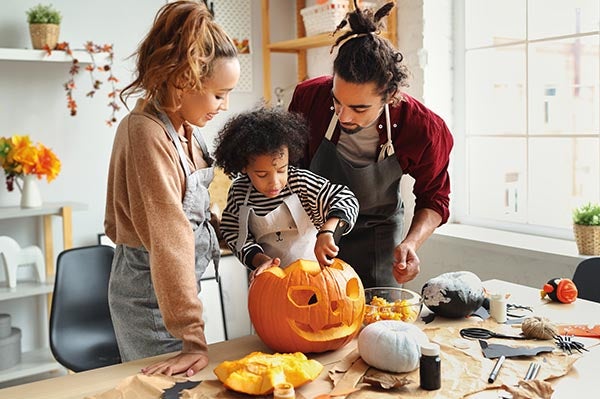
Jack-o’-lantern carving is a longstanding Halloween tradition. But with knives and sharp tools required to create these grinning masterpieces, there’s risk for minor and serious cuts. These typically occur if the knife slips, impacting the hand that’s holding onto the pumpkin, and while cleaning or resheathing the knife if it has a holder.
How to prevent:
- Supervise children and never let them handle a knife if they can’t do so safely
- Wear work gloves while handing the knife
If you do suffer an injury, the first and most important thing is to recognize the injury and stop the bleeding. Apply a clean cloth over the site and hold pressure for three to five minutes. This will stop the bleeding and also allow the wound edges to come together and a clot to be formed. Then clean the wound using soap and water—you don’t need to use peroxide or alcohol. If there’s any contaminants in the wound, like pumpkin, clean that out as well.
Once the wound is cleaned and examined, determine if medical attention is needed. Seek care at the emergency department or urgent care if the wound:
- Continues to bleed despite having put direct pressure for three to five minutes
- Is large and gaping with exposed tissue, which may require closure with staples or sutures
- Is extremely dirty with debris, which may need to be cleaned to avoid infection
Superficial wounds, on the other hand, can generally be managed at home with thorough cleaning, a topical antibiotic and dressing.
Burns from open flame candles
Candles are a major part of Halloween aesthetics, whether they’re used to illuminate a jack-o’-lantern or simply for some spooky ambiance. But open flame candles come with a high risk of burns. If located outside on a step or porch, a child’s costume could become inflamed. And if inside, there’s the chance of a child touching the flame or the candle getting knocked over, leading to possible human and property damage.
How to prevent:
- Opt for a battery-operated luminary light instead of open flame
- If you use an open flame candle, keep it outside away from the house and anything flammable
- Choose a flame-resistant costume (most labels have details on this)
If you do suffer a burn, we look at it similar to wounds—some can be handled at home, others require the hospital. If it’s a superficial burn, typically called a first-degree burn which looks like a sunburn, put it under cool water for three to five minutes. Sometimes an ice cube will help, as well.
Seek medical attention if:
- A large area of the body is burned (larger than the size of the palm of your hand)
- Blisters are forming
- Clothing catches fire
- The burn is in a highly sensitive area like the face or groin
Falling from a ladder
Many people love to go all-out when decorating for Halloween, stringing orange lights from the roof in true Griswold style and constructing a 12-foot-tall skeleton on their front lawn. However, a bad fall off their ladder could leave them with a half-finished project and serious injuries.
Ladder falls can result in bone fractures, soft tissue tears, contusions and head injuries.
How to prevent:
- Make sure you’re physically fit to climb the ladder and don’t have neurologic conditions or bouts of dizziness
- Use a spotter to help keep the ladder from moving
- Never go all the way to the top, which increases risk of the ladder becoming unsteady—only go halfway and have your spotter keep you informed of where you’re at on the ladder
Halloween candy safety
There’s no doubt that candy is the highlight of Halloween, especially for kids. After hours of filling their bucket with sugary, chocolate goodness, the urge to dive right into it is palpable. However, parents or a guardian must carefully examine each piece to avoid:
- Allergic reaction: If a child has a peanut or other food-related allergy, it’s important to take away the candy that either includes or may have traces of that allergen
- Contamination: Toss any unwrapped candy, which could have been tampered with
- Choking: Especially with smaller children, make sure the candy is appropriate for them to safely consume
Alcohol safety
Halloween isn’t just for the kids, with many adults heading to parties and bars to celebrate. Drink responsibly but also avoid mixing the above-mentioned activities (pumpkin carving, handling candles, climbing a ladder) with alcohol. And if wearing a costume, the same recommendations for kids apply to adults—be cognizant of impaired vision due to a mask and bring a light source if walking on uneven terrain.
Final words
While the festivities of Halloween do come with injury risk, it’s entirely possible to fully enjoy the night and not wind up in the emergency department with a cut, burn or sprained ankle.
It should be a fun time, a good time. A little bit of pre planning around safety can help ensure that everyone has a great Halloween, that everyone gets home safely at the end of the night and can enjoy the spoils of their trick-or-treating.