
Improving care and comfort: Inside Holy Cross Hospital’s Emergency Department renovation
April 8, 2026Categories: Blog Posts
Tags: Emergency Medicine
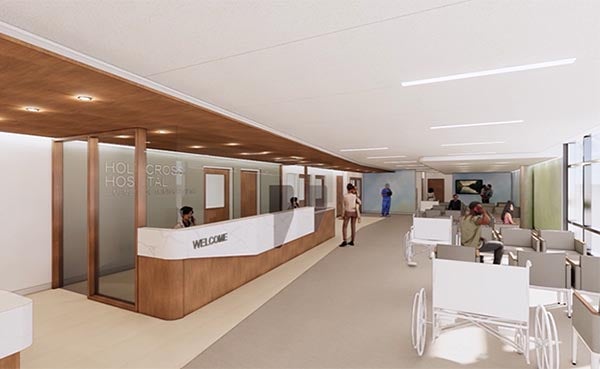 A visit to the Emergency Department is often unexpected and stressful—but at Holy Cross Hospital, a major renovation is underway to make that experience more efficient and, above all, comforting.
Over the next two years, the Emergency Department is being thoughtfully redesigned with intention at every step. From streamlined treatment areas that improve patient flow to calming design elements inspired by nature, the updated space aims to create an environment where patients and families feel supported from the moment they arrive.
According to Kate Wellner, VP of Operations at Holy Cross Hospital, a key component of the updated ED is the improved “fast-track” care of low acuity patients. Out of the current 65,000 patients the ED sees annually, over 30 percent are there for non-urgent issues, such as a sprained ankle, rash or other minor condition.
The new setup enables these individuals to undergo a physician evaluation in a private space before care is transitioned to a comfortable inner waiting room at the front of the ED. Not only does this allow patients to have privacy while speaking to a provider, but it also gets them on their way faster and frees up beds for the more severe cases.
“When we focus on that fast-track space, it’s about bringing all of the components up front—your labs, imaging. A large percentage of our volume is low acuity, so sniffles, breaks, bumps and bruises. We’ll get you in and out. We don’t need you laying down if you have a cold,” says Wellner. “You’ll go to an interior waiting room in a recliner—you never have to go in the back. The goal is to get that group moving fast.”
Thanks to this restructuring, the ED will have the capacity to treat an additional 10,000 patients annually.
Another major component of the renovation is to give patients and their families a more serene setting as they navigate the stresses that traditionally come with an ED visit. With a theme of “sacred healing,” the design is biophilic at its core.
“The color palette is blues and greens, very calming. The lighting isn’t just bright overheads. We’re trying to avoid that because it can be a lot for people,” says Wellner. “We wanted to be thoughtful with the design and incorporate natural elements. Even the desks are wood. There will be nature-inspired mosaics and murals on the walls. It’ll be pretty, and it’ll also be purposeful.”
The ED design was crafted with direct feedback from colleagues who use the space daily. Wellner describes the planning process as a “cross functional effort” to ensure patients and staff alike are benefiting from the project. From crash cart storage to the strategic placement of mandatory signage, every minute detail was mapped out.
“This really came from thinking about their workflow, and then the actual journey of a patient from the front of the house through the care process,” says Wellner.
Additionally, for the first time, the ED will have a designated safe space for behavioral health patients. While Holy Cross is not an inpatient behavioral health hospital, on-site crisis clinicians help medically stabilize and place them.
“But sometimes, the wait can be multiple days. We’ll have a behavioral health space where patients can have a bit more of a calmer environment. They’re able to make some choices on their own as they’re coming out of crisis. There will be sitting rooms for them and their caregivers with external light. It won’t just be a 4x4 room with white walls while they wait,” says Wellner.
Holy Cross will continue to have a separate seniors ED, as well as a pediatric area—two aspects that the community has come to know and appreciate. These spaces will also be redesigned with the serene, nature theme.
“It’s intended to be a more calming space for those who can become confused or stressed by what happens daily in the ED, and help them avoid the noise and frenetic energy that sometimes happens in the main acute fast-track area,” says Wellner. “We’re trying to be thoughtful about the things that we have in place that have worked.”
The ED renovation is taking place over four phases, each scheduled to last seven to eight months. Phase 1—the largest—is currently underway and includes the waiting and registration area, electrical rooms, IT closets and radiology department.
Throughout the duration of the project, which is slated to conclude in 2028, the ED will remain fully operational, with measures in place to minimize disruptions.